


FROGS: Fine Resolution Optimization and Gradient Smoothing


FROGS: Fine Resolution Optimization and Gradient Smoothing
Overview
Welcome to the FROGS project, an innovative approach to generating high-resolution images on memory-constrained devices. This project leverages pre-trained stable diffusion models and super-resolution deep neural networks (DNNs) to create a pipeline that generates high-quality images using minimal VRAM. By combining image post-processing techniques, FROGS aims to provide a solution for generating high-resolution backgrounds on devices with less than 8GB of VRAM.
Project Description
The motivation behind FROGS is to address the challenge of generating high-resolution images on devices with limited memory, without compromising on image quality. Existing solutions either require substantial memory or involve manual adjustments through external applications. FROGS offers a streamlined, on-device solution by integrating advanced deep learning models and optimization techniques.
Key Features
- Pre-trained Models: Utilizes models such as Lykon’s Dreamshaper V7, Latent Consistency LORA model, and Latent Diffusion Model (LDM) for super-resolution.
- Memory Optimization: Capable of generating high-resolution images with a fraction of the VRAM typically required.
- Image Quality: Combines super-resolution and gradient smoothing to enhance image quality and reduce artifacts.
Methodology
Dataset
The project utilizes pre-trained models available on Hugging Face:
- Lykon’s Dreamshaper V7: Lykon/dreamshaper-7 · Hugging Face
- Latent Consistency Model (LCM) LoRA: SDv1-5: latent-consistency/lcm-lora-sdv1-5 · Hugging Face
- Latent Diffusion Model (LDM) for super-resolution: CompVis/ldm-super-resolution-4x-openimages · Hugging Face
Image Generation Process
- Pre-trained Diffusion Model: Generates initial low-resolution images.
- Super-Resolution DNN Models: Enhances the resolution of generated images.
- Post-Processing Techniques: Applies gradient smoothing and alpha blending to improve image quality and remove seams.
Improvements
- Memory Profile Optimization: Reduces the memory required for image generation, making it feasible on mobile devices.
- Artifact Reduction: Enhances image quality by minimizing artifacts typically present in high-resolution images.
- Parallel Processing: Implements techniques to generate images in a parallel fashion, improving efficiency and speed.
Seam Removal Process
In the image generation process, seams may appear due to the merging of image quadrants. To address this, we apply a technique called alpha blending to seamlessly blend the overlapping regions.
Example Images
-
Prompt: person smiling at the camera
-
Image with Visible Seams and Overlapping Edges:
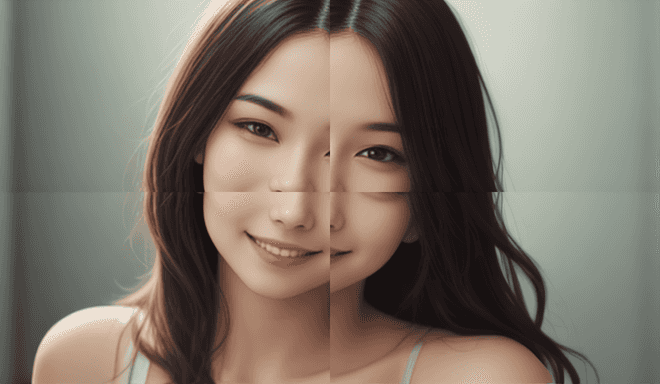
-
Seam-Removed Image:

Performance Metrics
- Memory Usage:
- Image generation: 1.5 GB
- Super-resolution: 7.7 GB (can be reduced to ~2.0 GB with CPU offloading)
- Time:
- Image generation: ~7 seconds
- Super-resolution: ~15 seconds
Results
FROGS successfully combines stable diffusion and super-resolution models into a single pipeline capable of running natively on memory-limited systems. The project demonstrates significant improvements in generating high-resolution images without sacrificing quality, even on devices with constrained resources.
Examples (See Slides Below)
- Celestial Clockwork: A depiction of a celestial clockwork with planets and stars moving in harmony.
- Japanese Cherry Blossoms: A serene Japanese garden in spring, with cherry blossoms in full bloom.
- Winter Wonderland: A magical snowy landscape with a cozy cabin and a penguin.
- Space Odyssey: A stunning view of a distant galaxy from the window of a spaceship, with planets and stars.
- Aurora Over Mountains: Northern Lights dancing over snow-capped mountains under a starry sky.
- Redwood Forest National Park: Photorealistic depiction of a redwood forest.
Future Work
- Porting to MacOS/iOS: Adapt the program for Apple’s ecosystem.
- User Interface: Develop a user-friendly interface for easier interaction.
- Executable Compilation: Compile the program into a single executable for easy deployment.
References
For a detailed list of references, please refer to the complete research paper.
Paper



Harrison is a senior ECE student at Northeastern University with a passion for research and innovation. He currently works as a research engineer in the Traverso Lab at Brigham and Women's Hospital and MIT, where he explores the intersection of machine learning, computer vision, and embedded firmware in the field of individualized medicine.